Lights On Leadership: How to Keep Your Light Shining Under Pressure
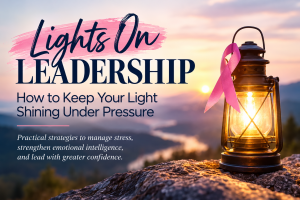
Lights On Leadership begins with a simple question: How do you keep your light shining when people or circumstances threaten to knock it out?
Practical strategies to manage stress, strengthen emotional intelligence, and lead with greater confidence.
Have you ever started your day with the best intentions to encourage, connect with, and positively influence the people entrusted to your care?
You feel focused, confident, and ready to make a difference.
And then—SHAZAM!
You encounter someone or something that knocks your lights out. Metaphorically speaking, of course!
Perhaps it’s a difficult conversation, an unexpected setback, a critical comment, or someone whose behavior pushes every button you have.
Suddenly, your positive intentions take a back seat as frustration moves into the driver’s seat.
You replay the encounter in your mind. You feel your energy slipping away. You may implode, explode, withdraw, or find yourself reacting in ways that don’t reflect the leader you want to be.
Sound familiar?
Here’s the good news: You don’t have to give outside circumstances the power to determine whether your leadership lights stay on or go out.
Who Has the Power to Flip Your Switch?
One of the most important lessons I’ve learned through more than 30 years of coaching and leadership development is this:
Stress is the power we give to outside circumstances to define our worth, value, and what we believe we are capable of handling successfully.
Think about that for a moment.
How often do we hand over our emotional well-being to someone else’s attitude, behavior, or opinion?
We cannot always control what happens around us. We cannot control what other people think, say, or do.
But we can develop greater awareness of how we respond.
That’s where emotional intelligence becomes a powerful leadership advantage.
Emotional intelligence helps us recognize what’s happening within us, regulate our reactions, understand the experiences of others, and choose behaviors that strengthen rather than damage relationships.
The goal isn’t to avoid difficult people or challenging circumstances.
The goal is to keep your lights on even when life gets foggy.
What Breast Cancer Taught Me About Keeping My Lights On
October is Breast Cancer Awareness Month, and as someone who has personally walked through breast cancer, I understand how quickly life can change.
A diagnosis can introduce uncertainty, fear, and questions you never imagined having to face.
During challenging seasons, I’ve learned that keeping your lights on doesn’t mean pretending everything is wonderful or denying difficult emotions.
It means acknowledging what you’re experiencing while intentionally choosing where to place your attention and energy.
Sometimes keeping your lights on means asking for help, allowing yourself to rest, establishing healthy boundaries, or simply taking the next step.
The same principle applies to leadership.
Whether you’re navigating a health challenge, organizational change, a strained relationship, or a demanding workplace, you have opportunities to respond with greater awareness and intention.
Resilience isn’t about never getting knocked down. It’s about learning how to recover, reconnect with what matters, and move forward.
Apply the ABCs of Lights On Leadership
The ABC Framework—Awareness, Behaviors, and Connections—created by Jenn Chloupek, M.Ed., PCC, my co-host on the ABCs for Leadership & Life podcast, offers a practical approach to navigating challenging moments with greater emotional intelligence and intention.
A — Awareness: Notice What’s Happening
Before reacting, pause and become curious about what’s happening inside you.
Ask yourself:
- What am I feeling right now?
- What story am I telling myself about this situation?
- Am I responding to the facts or to my interpretation of them?
- What is within my control?
Awareness creates space between the trigger and your response.
That space is where leadership choice begins.
B — Behaviors: Choose Your Response
Once you become aware of your internal experience, you can choose behaviors that support your desired outcome.
Instead of reacting impulsively, consider:
- Take a slow, intentional breath.
- Release the need to control another person’s response.
- Speak with honesty and respect.
- Focus on solutions rather than blame.
- Choose one constructive action you can take.
Remember, you don’t have to attend every argument you’re invited to!
Your behavior is one of the most powerful ways you communicate your leadership values.
C — Connections: Lead With Intention
Leadership is about influence, and influence grows through connection.
When stress takes over, relationships often suffer. We may become defensive, impatient, critical, or disconnected.
Keeping your lights on allows you to reconnect with the person in front of you.
Ask yourself:
- How can I bring clarity rather than confusion?
- Am I listening to understand or simply preparing my response?
- What does this person need from me right now?
- How can I contribute to a more productive outcome?
People may not remember every word you say, but they often remember how they experienced you during difficult moments.
A Simple Practice: Pause, Choose, and Proceed
The next time someone or something threatens to knock your lights out, try this simple practice:
1. Pause. Notice your physical and emotional reaction before speaking or acting.
2. Choose. Ask yourself, “What response reflects the leader and person I want to be?”
3. Proceed. Take one intentional step that supports a positive outcome.
And if you don’t get it right the first time?
Repair, learn, and try again.
Leadership growth isn’t about perfection. It’s about increasing awareness, strengthening intentional behaviors, and creating healthier connections.
Your Lights On Leadership Challenge
Consider one situation in your professional or personal life that consistently drains your energy or triggers frustration.
Rather than focusing on changing the other person or circumstance, ask yourself:
“What can I do differently to keep my lights on in this situation?”
Perhaps you need to establish a boundary, release an expectation, have an honest conversation, or stop replaying something you cannot change.
Small, intentional shifts can produce meaningful changes in how you lead, communicate, and experience your day.
Remember: You cannot always control the fog around you, but you can choose how you navigate through it.
Keep your lights on. Your leadership matters.
Ready to Stress Less and Lead More?
Leadership begins with how you lead yourself, especially when circumstances challenge your confidence, clarity, and emotional well-being.
Discover practical tools to manage stress, strengthen emotional intelligence, and positively influence the people entrusted to your care. I am faculty for the Lights On Leadership training program created by Cathy Hawk, Clarity International for more information on programs click the programs tab at the top of this page to explore the drop down menu of options.